Sunday, September 23, 2012

A Figgy Embrace for GGW Picture This Contest

The theme for this month's Gardening Gone Wild photo contest is Awakening - something that's already happening in Austin and coming soon to more Northern gardens, long under snow.

Thalia the Muse of Comedy influences many of my posts and today I'll let her rule my photos, too - this photo of my Celeste Fig Tree waking up amused me because it seems to be stretching and reaching out and declaring, "Embrace Spring!"AnnieinAustin,Figgy EmbraceHappy Spring to all of you!

Saturday, September 22, 2012

Arches National Park :: Devil's Garden

It was early on Thursday morning (May 13th) when I arrived at Arches National Park, which is north of Moab, Utah. And the awful weather of the previous two days had finally drifted away! It was a beautiful day. The campground is 18 miles from the entrance station and visitors center. Bypassing the latter for the time being, I drove on out to the campground in hopes of getting a campsite for the night. I was dismayed to discover that this year the campground was switched to a reservation only system.

This meant that I “might” get a site if someone canceled or was a no-show. There was an older gentleman who arrived at the same time I did. The camp host was very nice in explaining the situation to us and, luckily, said that it was likely that “something” would be available later in the afternoon. He suggested that we go take a hike and return about three o'clock.

So, that's what I did. The Devil's Garden Trail was just down the road and since it was still early (about nine o'clock) there was plenty of parking available. This trail is the longest of the maintained trails in the park and goes to eight arches with views of several others. It is actually a series of trails with a total length of 6.2 miles round-trip. It wasn't “easy” by any means, but overall it wasn't all that difficult with the exception of several crucial spots that involved scrambling over rocks and walking along the tops of fins (large, very long, sometimes narrow rocks).

Pine Tree Arch.

Tunnel Arch.

There were several groups of school kids on the trail.

Landscape Arch, taken at an angle to get the entire length in one shot, even then I didn't get the ends of it completely. At 310 feet long (with a 290 foot span), it is reportedly the longest freestanding natural arch known to exist. At its thinnest point it is only six feet thick. When I visited the park in 1979 there was a trail where you could walk under the arch. (Somewhere, I have a photo from that trip that shows someone walking on the arch!) It has become more fragile with age, and several large chunks fell off in 1995, so for safety reasons and to help preserve it a little longer they closed the trail that went underneath the arch.

There was a bit of a bottleneck with the school kids traversing the rocks. The trail split a short distance ahead. They went one way and I went the other!

A southwest view of the valley from near Navajo Arch.

The valley view through Partition Arch, looking east.

A portion of the trail went along the top of a fin, with the “added bonus” of several rocks on top, which provided challenging obstacles. It was about 25-30 feet to the ground.

Fins alongside the trail.

Fire and Ice


Zebra Swallowtail (Eurytides marcellus).


Captured during his unannounced guest appearance at the Fire and Ice show1.

Alabama Power's indiscriminate and ugly tree-removal policies have saddened me every time I drive this road.2


But when the sun warmed that questionably broad path, I was surprised at what popped up.


Wild hyacinths (Camassia scilloides). They dot the woods beyond the power lines, but this much sun exposure (and no late killing frost this year) caused a population explosion.

I doubt they'll last here long -- brush will dominate within a year or two, choking out anything this small.

But obviously, they can lie dormant, waiting for the day when they feel the sun again.

-----

1Fire Pinks and Wild Hyacinths

2They don't practice quite so much dogwood-twisting tree torture in ritzy lawyer-heavy Birmingham suburbs, but out here in rural areas, I'm sure they figure no one of importance will mind.

-----

Friday Ark.

Friday, September 21, 2012

All in all it was a good day

Went to Peru. . .

The Marriage Record for May Hale and George Armstrong did not include parental information.

The Death Record for May L. Armstrong (Miami County Health Dept. Book C-5 page 5, December 18, 1899) gives her parents as Albert Hale and Elizabeth Foutz. So she is NOT the daughter of Jacob and Rosanna (Wise) Hale. I didn't get a death certificate as it would have cost $10. I was fortunate that the clerk allowed me to look at the record. Afterwards, she said "for future reference" in case I needed additional searches, they are supposed to charge $35 per half hour for lookups, plus the charge for the certificate!

The Estate Packet for Christina Wise was found in the archives building! Got my hands dirty ;-) I "made copies" of all the documents in the file using my camera since photocopies were $1 apiece! Most came out quite well, with a few being a little soft in focus, but they can be read.

In addition to the people already named in a previous post, there are documents that mention William Wise and John Wise, though no relationships are given.

There was a statement (see image below) signed by Rosanna Hale (her mark) and witnessed by M. H. Grunden which fits in quite nicely with the census information found by Pseudo-Anonymous Gary earlier this week (which also prompted this overdue visit to Peru). In the 1900 census for Steelton Borough, Dauphin County, Pennsylvania (page 55B), Rosana Hale is listed in the household of Martin H. Grunden as widowed, mother-in-law.


There is no date on this document, but similar ones for William Kircher and Luella Culbertson were dated October 4, 1887. It reads: "Whereas, the assets in the hands of William Kircher, Administrator of the Estate of Christina Wise, deceased are insufficient to pay the claims allowed against the same in full - to avoid the additional expense of settling said estate as insolvent, I, Rosanna Hale, consent to accept, and hereby acknowledge the receipt of about eighty-three per cent of my claim against said estate, to-wit: Seventy-seven & 27/100 Dollars, in full payment and satisfaction of said claim. Witness M. H. Grunden. Rosanna x Hale, her mark."

Found the deed book entry where Peter Wise and his wife, Christina, sold their 180 acres of land on April 5, 1866 for $8,000.

On May 14, 1866 Peter purchased town lots 5, 6, & 7 in Gilead. On October 26, 1868 he purchased 5 acres of land that was bordered on the east by the town of Gilead.

Those two entries in 1866 were in one of the books I had skipped on my previous visit to the courthouse a month ago. The reason I had skipped over them was because in the 1870 census it still showed that Peter owned land. What didn't "click" though was the fact that in 1850 his real estate was valued at $4,000 while in 1870 it was only $1,000. Lesson learned: Check all records for the time period of your ancestor, not just the years you think there "might" be transactions.

However, I didn't find the records for the sale of the lots and 5 acres under the Wise surname. So I checked for transactions by William Kircher, the administrator of Christina's estate, and found the record of the sale of the five acres on April 15, 1887 and the sale of the town lots on September 10, 1887.

As a point of reference, this is a portion of the 1860 census for Seward Township, Kosciusko County, Indiana page 60. After looking at it for a while I can now see that it could be Mary A. rather than May A., but then again, maybe not.

Wednesday, September 19, 2012

Gunks Routes: Blistered Toe (Direct 5.9+) & Double Crack (5.8)


(Photo: Gail getting started on Higher Stannard (5.9-).)


A pattern has started to develop.


I go to the Gunks.


I pick a 5.10 to try.


I struggle.


I back off of that 5.10 and do something else.


At the beginning of July this was what happened when I decided to try Simple Stuff (5.10a) with Gail. It was a super-hot, miserable day. We had planned on just doing a half day and had started early to beat the heat, doing the first pitch of Higher Stannard (5.9-) at 6:30 a.m.


I really enjoyed doing Higher Stannard again. It was one of my favorites last year and it was just as good the second time around. It was a little stiff for a warm-up but I cruised through the thin crux, feeling strong. It seemed like a good omen.


Then we trooped on down the cliff to Simple Stuff.


It is an unusual climb for the Gunks. It is no jug-haul, but rather features a sustained stemming corner. It is one of those climbs people mention as a good early 5.10, I think because there is pro available in the corner almost the whole way to the chains. Others, however, think it is a bad choice for an early 5.10 because it is sustained, and because people have gotten hurt when they have fallen in the initial moves, cracking ankles before getting established in the corner.


(Photo: The overhanging corner ascended by Simple Stuff (5.10a).)


I didn't get very far. Climbing up to the first difficult moves, I was very careful to place pro often. I got through a hard move and found the position very pumpy. I had a solid nut but I wanted to place something higher up before committing to the next bit. Unfortunately I could not get anything I had real confidence in. I tried getting another nut but I couldn't make it stick. Then I tried a small C3, eventually working it into a crack but not feeling really happy about it. By this point I had worn myself out and took a hang. The C3 creaked a bit, which was disconcerting. I did not relish the thought of taking a fall onto it.


It was suddenly so hot outside. I was drenched with sweat. This climb was just beginning and I was already struggling, climbing scared, very tentative. I wasn't at all sure I was ready for this.


I decided this wasn't my time for Simple Stuff. I left the bomber nut as insurance and downclimbed to the ground.


(Photo: Happy to have finally cleared the bulge on Blistered Toe Direct (5.9+).)


Still hoping to wring some progress from the day, I suggested to Gail that we do the nearby Blistered Toe Direct, a climb which had defeated me last year. I had tried it with Parker, making the first hard move up to the horizontal. But I hadn't found a way to get over the bulge that completes the direct start.


This time I hoped to get it done. And eventually I did. But not without a few false starts.


Depending on your height, the direct start has either one or two hard moves. If you are short like me, it is a challenge just to step up onto the wall and reach a good crimp that will allow you to reach up to the good horizontal. If you are tall, I envy you because you can just reach the crimp or maybe even the horizontal from the ground. Whether you are tall or short, you can protect the first move with a great nut placed over your head from the ground. (Clip it short by just placing a single biner on the nut.) Then you can get a good cam once you reach the horizontal.


The next move is what still gave me trouble. A pebbly ball of rock looks good but is very hard to use effectively. I struggled with it a couple of times before a little advice from Gail on turning my body and getting my feet up got me to the breakthrough.


Finally! I could put this 5.9+ in the bank. Next time I hope it will seem easy.


This direct start is a worthwhile little puzzle, I think, and the payoff is that the rest of the first pitch of Blistered Toe is awesome. It isn't a long pitch but it is steep and fun, with some nice layback moves and reaches up a natural line to a ledge with a bolted anchor off to the left. Considered without the direct start, Blistered Toe is one of the better 5.7 climbs in the Trapps, I'd say. And the direct start makes it even better. It is an under-appreciated small gem.


After we were done with Blistered Toe, Gail suggested Double Crack, a climb I had led once back in . I thought it was great back then and nothing about my experience in changed my opinion. Back in the day people would do a belay at a small ledge part of the way up the cliff but nowadays most everyone does the climb as one sustained 150 foot pitch. The hardest part comes early, in the first 20 feet, but even though the angle thereafter eases off a touch, it remains steep and consistent the whole way to the finish. Classic Gunks-style climbing, with overhanging reaches between good holds.


I wouldn't recommend Double Crack when it is nearly 100 degrees out, however. It seemed to go on and on. At one point Gail told me that I was glistening in the sun, I was sweating so much. I think I lost several pounds of water weight on this climb.


As we left the cliff I questioned whether we really should have come out at all. Climbing in the miserable heat can get you down. After just half a day I was exhausted and happy to call it quits.


Ice Arch Sunrise


This winter has been quite productive when it comes to having interesting ice formations to photograph, much more so than last winter. December and January had plenty of very cold days which meant that there was quite a bit of ice both along the shore and floating around in various places on Lake Superior. Near the end of January we had a wind storm that came up and blew a lot of this ice onto the Minnesota shoreline of the lake. Just north of Grand Marais was one area in particular where the ice had been jammed into many fascinating forms along the beaches. The wave action not only resulted in the packing of the ice along the shoreline, but also contributed to the hollowing out of the ice from underneath in several places. Several ice arches were formed as the waves continued to work at the ice from below.
The arch shown in this image was the most photogenic arch that I found. On the morning I made this image I was photographing the shoreline with my friend Paul. It was a very calm morning which was a stark contrast to the previous days which had made all these ice formations possible. Paul and I set up our tripods and started making images of the arch. We had only taken about 5 or 6 images each when we heard a cracking sound. Both of us were in the process of moving our tripods to set up a different shot when we heard the cracking. We both looked up just as the arch collapsed into the water. Needless to say, this scene was a lot less interesting to photograph after the arch fell. Thankfully we each got a few images before it was gone! This image was made at 8:03 AM using my Canon EF 17-40mm lens. Shutter speed was 1/15, aperture f16, ISO 100.

The Death of Ruth Joslin :: 1830

Official death records were not kept in the early days in Ohio. Then, as now, people often relied upon the local tabloid for news of their friends, neighbors and relatives.

Carol Willsey Bell compiled "Delaware County, Ohio Genealogical Abstracts" in 1980 and on page 51 we find the following entry, citing the Ohio State Gazette: "Sept. 16, 1830 - Died in Liberty Tp. on 27th ult, MRS. RUTH JOSLIN, w/o Jonas, age 59 years." The term "ult" refers to the previous month, i.e. Ruth died on August 27th 1830.

In 1992, Mary V. Reed compiled "Abstracts from Miscellaneous Delaware County Ohio Newspapers 1821-1857" and on page 49, citing the Ohio State Gazette and Delaware County Journal of September 16, 1830 is the entry: "Died in Liberty Township on the 27th ult. Mrs Ruth JOSLIN, aged 59 years wife of Mr. Johns JOSLIN."

From another "Joslin" researcher, I found out that Ruth's tombstone resides within the confines of the Delaware County Historical Museum, or at least it did several years ago. The inscription was transcribed as "Ruth wife of Jonas Joslin died Aug 27, 1830 aged 59 Years."

In this online listing, Ruth is shown as having been buried in the "Joslin Cemetery" along with Jonas Sr. The cemetery is shown as #9 on this map and was located in the southern portion of Liberty Township near the Franklin County line. From its location, I am presuming that the cemetery was on the Joslin farm.

Tuesday, September 18, 2012

The new Petzl Quark

The is a repostfrom earlyApril . But as we roll into the fall ice season andthe winter of / I thought it worth revisting for those looking to buying new tools. I'll have a new Nomic/Fusion comparison up soon as well. And a new Cobra/Quark comparison. And finally, since so few have gotten to use the newest Ergoanother set of comments on that tool as well from some recent alpine climbing with it.


New Quark buried in Neve with a lwt C-T adze.


Hardly new now as the first tools showed up here in the States back in Oct/Nov. of . The issues with the new Nomic and Ergo appeared and for one reason or another even the unaffected Quarks weren't available in large numbers again until mid Feb. . I played with a pair at the Bozeman Icefest. But wasn't able to get my own pair until the week before I left for Chamonix in late March.For may folks in the warmer parts of the USthe ice season was winding down by that time.the tools were available again. Hard to justify new tools at full price at the tail end of your season not knowing what will be available next year.


(I don't know ofanything new coming along for -)


More than a few waiting for the new Nomic. The Nomic may be worth the wait for some but easy to over look the more durable and likely a better all around tool, theQuark. Many will have a the option of even more/better choicesfor their own use by having the new all around Quark and the even more technical (than the Nomic) new Ergo available.


The new Quark is certainly built in the Nomic's image. The handle contours are very close and most importantly the aluminum heads are exactly the same profiles.


You have to look back at the original Quark to make a good comparison. Petzl has changed more than just the head of the tool. But changing the head made a new hammer and a new adze required on the newest tool. Even the picks were changed. Making them nowT rated instead of B rated in bothversions, the new ICE and New DRY. Add to that you get a slightly deeper pick angle on the newest Quark.


Below: pictured isthe new pick angle on the top over lay. The new pick is slightly steeper, may be 2 degrees.. Middle is the newestICEpicktip profile. The DRY versionis the same tip profile. The bottom picture is the older Cascade Nomic pick profile.


So as you can see, it aint your old Quark. The new Quark with a hammerweights in at 588g or 528g with no hammmer. The old Quark with a hammer installed is 682g.


With the new Quark that includes a second higher grip in both over all weights. With after market hammers and adzes available for the new Quark and the additional factory movable second grip the new Quark has a lot of options.


The newest Petzl factory hammer on the left on a new Quark. The C-T hammer on a original styleNomic right.Weights vary from 30g for the low profile C-T hamemr to 60g for the Petzl hammer.


The other improvement that Petzl made on thenew tool is a full size carabiner hole in the spike to clip umbilicals into. Big improvement.


This one ofmy personal Quarks, with fixed trigger for high daggering, a rubber grip wrapand a C-T hammer installed. Lots of options on how you set this tool up. And an incredibly versatile tool on any terrain. The Adze in the opening photo is its mate.


Snow slogs...


Used here to good effect onhard technical dry tooling. Jack Roberts on a bolted M7+ @ adry tooling area in France.


I have climbed with the Nomic almost exclusively since it became available. The Quark before that. Abandoning every other tool in my quiver sometimes to my detriment. Only the new Ergo has swayed me untilnow. The new Quark has taken the majority of technical advantages of the Nomic and added them to a more vestal shaft of the older Quark. All the while giving you a majority of the Nomic'sadvantages in one form or another (the moving slider grip) while offering some additional advantages on less technical ground. The new Quark is one of the few tools imo that rivalsand generally betters the original Nomic as a truly all around tool. Seems I am not the only one who thinks so. I suspect this guy at any given moment has a choice of ANY tool that Petzl makes. You think?


Hard not to be pleased with the newest Quark. For many the Quark will be a better (and more appreciated) all around tool.

Saturday, September 15, 2012

Trail Running Challenges


On the way to the trailhead... Ehhhh


On the way home... Ahhhhh

Recently running has felt different. It seems summer has finally hit the Laurel Highlands. It's been really warm and humid, with storms plentiful especially this past week. I managed to get rained or stormed on several times. The weather was in the lower 90's with the humidity similar or higher. My body has been holding up well to the quick increase of mileage. I've been pushing a little harder, but trying not to overdo things. Being able to run again feels so good and I don't want ruin it. I've been rebuilding my ski injured body with the dreams of pulling off a LHHT double as early as fall (or spring '14). During this rehab and training I've been reading more on Challenges and FKT's (fastest known time's). I'll try to explain the way I understand them. Competing for aFKT's is simply trying to achieve the fastest time over a predetermined course/trail, alone or in a group, but not an organized race on a designated day. They can be short 5K runs or long trails like the Appalachian or Continental Divide. They can be completed any time you choose. No set date, even worse yet, weekend. Only success or failure awaits with only one person holding the FKT. The honor system applies, although for major or serious FKT records tracking devices are utilized for proof. Challenges are different because they're a personal goal to complete, not a race. Did you accomplish the course set out and if you have already, could you do it quicker? Challenges are more about personal accomplishment, although most have a FKT as well.


While browsing around, I stumbled upon this challenge here in my back yard. Its called theOhiopyle 50K (Gate-to-8 X 2) posted on the North East Ohio Trail Club (NEO Trail Club) website. I'm not a member of the club, but found the posted challenge. Whether you have to be a club member to be listed after completion I don't know. Either way, it gives me a goal to accomplish that I haven't done. I know I'm not in super woodz ninja shape right now, so I figured it was time to incorporate the Gate to 8 section of the Laurel Highlands Hiking trail into my week of running as well as some other quicker tempo runs.


Recent runs


The Barn at Bear Run Nature Reserve


Tuesday 7/2 Laura's Tiny Tulip Traverse, 5 miles - This is a run that Laura put together after my Bear Run Trail Run challenge. What a great 5 mile (apprx.) loop in Bear Run Nature Reserve. It follows Tree, Rhododendron, Tulip Tree, Snowbunny, Rhododendron and Tree Trails in a counter clockwise lollipop. The route climbs 718' and is on some pretty amazing trails (especially Tulip Tree) It was my first time running this route and I wanted to apply a reasonable effort. I ran the wonderful course enjoying the steepening climb from the car up to Tulip Tree... Tulip Tree is freakin' fun. What else can I say. This is the best .8 mile trail I've ever run. It is so fast and dabalicious. Quick footwork on slightly downhill single track, runners high for sure! It had to be built by runners. I wish it was way longer. Snowbunny leads back across the hill and down to the early trails you started on, then finishes at the sign-in. Warm and humid as described above. Ran the course in 45:41, with one routing mishap.


Wednesday 7/3 LHHT Gate to 8, 15.75 miles - I was planning on running to MP 10 and back for 20 miles, but... Everything was going well. I ran an "easy" pace NOBO, hiking most of the hills. I was hearing some distant thunder while climbing up "heart attack hill" towards MP7. By the time I had MP 8 in sight, the sky was quite black and the thunder was persistent. Retreat was my thought. I barely took 20 strides SOBO and the skies opened up and the rains came... and came... and came. I bombed heart attack hill in a muddy running creek with extremely limited visibility. My visor helped, but I found its limitations. It was similar to winter white-outs I've experienced. My nonchalant pace quickened on the return trip with rains stopping and skies clearing briefly for about a mile. Despite the heat, slippery trail and slug like pace I managed a 3:23:44 overall. X2 laps would put me under 7hrs for the 50K Challenge. Seems like a good start. Elevation +4081, -4064.


Thursday 7/4 Bear Rocks Loop, 4 miles - It was the Fourth of July. I squeezed in a short, slow, road run in the sun. Ran the loop in 29:03. Elevation +416, -406. Not much to say.


Thursday 7/5 Yough River Trail, 2 miles - Ran with Laura and her sore knee. Rest day, spent most of it lounging by the river at the Oasis...AHHHHH! Then went running. 22:08.


River art = Rart at "The Oasis"

Friday 7/3 LHHT Gate to 8, 15.75 miles- It was 91° which seemed perfect for another training lap of Gate to 8 ;) I figured that If I practice in conditions like that, surely a more comfortable day will feel slightly easier? The cooler months have been when other (wiser) people have done it. I'll try in August and then hopefully improve on that later in the year under favorable conditions. I went out intentionally slow trying to adjust to the heat. Humidity was really high and in no time I was sweating buckets. The overall trip was very hot with a flash storm popping up and tagging along with me for about 45 min. Compared to the dumping on Wednesday this was nothing. I did pass another trail runner around mile 4. We were both moving quickly and gave a wave without stopping. I ran out of water coming up the last hill before MP 3. I should've stopped at the stream to at least fill a handheld. Finished the run in 3:31:03, incredibly hot and thirsty.
Weekly rundown5 runs8hrs31min.42 milesElevation +9,405', -9,306'

Thursday, September 13, 2012

Comfortable Carbon: Trying the Parlee Z5

Parlee Z5

Looking down at my handlebars around mile 50, I felt a pang of alarm at the sight of unfamiliar decals. Then I remembered: I wasn't riding my own bike. I had gotten so comfortable, I'd forgotten. A stern voice in my head began to chastise me. "Come on, you are doing a test ride. You're supposed to be paying attention to the ride characterisics - not enjoying the scenery." Easier said than done!


To explain how I came to test ride the Parlee Z5, it may help to give a bit of a backstory. For some time, I've been interested in getting a feel for carbon fiber roadbikes. However, my attempts at this have been less than successful. I've ridden a handful of carbon bikes briefly, but either they were not set up for me to do a proper test ride, or I found the ride quality too harsh to actually want to ride them for any length of time. Of course not all carbon bikes feel the same, just like not all steel bikes feel the same. With this in mind, I finally approached the matter more strategically and talked to some industry insiders familiar with my riding style and preferences. A few suggestions kept coming up. Among them was the Parlee Z5.


Parlee Z5

Parlee Cycles are a small and local-to-me company, based in Beverly, Massachusetts. So the idea of trying one of their bikes was appealing. Later this summer I plan to visit the factory and write about them in more detail. Parlee offers both custom frames, built on the premises, and production models designed inhouse and built in Taiwan. The Z5 is the latter.


The demo bike was lent to me by Cycle Loft, a Boston Parlee dealer. After undergoing a fitting session, my position on the Z5 ended up near-identical to that on my own roadbike, making for a seamless transition. I kept the bike for a week and rode it for about 135 miles.


Parlee Z5

Even before I rode the Z5, I could see why this bike was suggested to me. To call its appearance "classic" might be pushing it. But the aesthetic is clean, subtle, neutral. I did not find myself biased against it, in a "Meh, this is ugly" kind of way. In fact, I find it rather pretty.


Parlee Z5

Made from a single carbon piece (what is known as "monocoque construction"), the Z5 frame has a seamless, sculpted look to it. At the same time, the round tubes and the smooth, but crisply delineated joints, bear a resemblance to those of metal bikes. There are no MC Escher-esque bulges or round-to-square taperings here; the frame looks simple and familiar. For those who are curious to try carbon fiber but wince at the look they associate itwith, I do think Parlee eases the transition.


Parlee Z5

I rode the Parlee Z5 in size Small (Tall), which translates to a 52.5cm top tube and a slightly extended headtube compared to their standard Small. The complete geometry specs are here. The bike was fitted with a SRAM Force group andMavic Ksyrium Elite wheels with 23mm Michelin Pro 4 tires (complete build specs here). Though I have Campagnolo on my own bike, I feel very comfortable with SRAM and have no trouble switching back and forth. The handlebars included in the standard build were 2mm narrower than the (42mm) bars on my own bike, but otherwise the fit was almost identical.


Parlee Z5

The one disappointment was that the front-center was a bit tighter than I like. With 23mm tires, I had a tiny bit of toe overlap. The amount was minimal, and I still felt comfortable test riding the bike. But with 25mm tires I would not be.


Parlee Z5
Riding the Parlee home, my first impressions were dominated by how comfortable it felt - namely, the ride quality over harsh roads, bumps and potholes. To provide some background, I am pretty sensitive to ride quality and cannot stand a bike that feels harsh. It does not matter how fast it is, how nimble, or how good at climbing: If I feel vibrations from the road or pain from going over bumps, I just can't take it for more than a few miles. This sensitivity was a big factor in my own roadbike purchasing decision a couple of years ago, and a major reason I went with a titanium Seven. So with that as my personal bike, granted I am now a bit spoiled in the ride quality department. Lots of bikes feel at least a little harsh compared to my Seven.


Lots of bikes, but not the Parlee Z5. Nope. The Z5 was flawlessly smooth. As in zero road buzz sensation, zero pain over bumps and potholes. At some point I started intentionally riding it over every stretch of broken pavement I could find, but I couldn't feel a thing.


Of course, whether it feels painful or not, a roadbike with skinny tires will still toss you around on bad roads. And it is here that I could feel a difference in the Z5 compared to my own bike. Until now, I had considered my Seven to be quite stiff. But after some time on the Parlee, I could feel a "give" in my own bike that I had not detected before. In comparison, there is no give to the Parlee at all; on bumpy roads it sort of bounces as one unit rather than exhibit even a slight amount of yield.


Parlee Z5

But despite being stiffer, the Parlee did not feel harsher than my own bike, even as I rode it longer. To my surprise, neither did it feel faster. I rode alone and I rode with some fast friends. Each time, speed and effort-wise, it felt just like being on my own roadbike.


I decided to ride the Parlee on a 100K New England Randonneurs "Permanent" course I had done alone a few weeks earlier (67 miles, with 3,800 feet of climbing). Just as I'd done previously, I timed myself and genuinely tried to do my best. My average rolling speed on the Parlee was 13.3mph, whereas on my own bike it had been 13.1mph - a difference too small to be significant, considering that my fitness had also increased a bit since the earlier ride. Of course this bit of anecdotal evidence may not mean much. But it reflects my subjective experience of the bike.


One reason I picked this particular 100K route for the test ride, was for its brief unpaved stretches. The bike rode on broken pavement so nicely, I was curious how it would do on dirt and gravel. Just as nicely, it turns out. While I prefer to do unpaved rides on wide tires at low pressure, if I must ride skinny tires the Z5 is as good as it gets.


Parlee Z5

Aside from all this, I did feel something distinct to this bike in the course of my test rides. It was a sensation in the rear triangle - possibly the chainstays, and it was specific to cornering. It was as if the rear responded to cornering differently from what I am used to. The chainstay area felt lighter somehow, almost as if it wanted to skip or lift off on corners. Well, maybe describing it that way makes it sound too negative. Unfortunately, I don't know how to explain it any better, but I actually liked this sensation. I found the bike to be maneuverable on corners in a way I had not previously experienced.


Normally, I am pretty sensitive to a bike's front-end handling, and less so to other aspects. The Parlee was the first time I was struck by characteristics specific to the rear of the bike.


Parlee Z5

While technically not the first carbon fiber roadbike I've ridden, the Parlee Z5 is the first one I've put a sufficient number of miles on to warrant a report. In part this is thanks to Cycle Loft, for lending it out and setting it up to fit me perfectly. And in part it's thanks to the bike's comfortable feel, which made me want to keep riding for miles and miles. Much like on my own bike, I did not experience fatigue on the Z5 after strenuous rides. And much like on my own bike, the handling, for the most part, felt "unnoticeable" - encouraging me to focus on the scenery and the ride itself, rather than on the bike.


Going into this test ride, I had several expectations about the feel and performance of carbon fiber: Namely, that it would feel harsher, stiffer and faster than my own bike. The Parlee Z5 felt only stiffer, and even that was only noticeable to me under certain conditions. Granted, I don't race, I don't ride aggressively, I spin rather than mash, and I don't climb out of the saddle. My impressions are limited to the kind of riding I do. And that riding involves 50-100 mile jaunts, sometimes more, usually with lots of climbing and usually on bad roads.I like a fast bike that makes me feel weightless. And I also like to be comfortable. As far as that kind of riding goes, I felt right at home on the Parlee Z5.

Tuesday, September 11, 2012

California :: Point Mugu

While serving in the Navy, I was stationed at Point Mugu during the years 1974-1977 and lived nearby at Port Hueneme and Oxnard. The last time I was there was in 1979 upon my return from Japan.

Many things have changed, but unlike a few other places I've revisited, I also found that some things were the same.

My apartment was only a few blocks from the beach and the park at Port Hueneme. The park has been expanded and improved. In fact, there was work going on during my visit. Condominiums and large apartment complexes have been built along the shore. Surprisingly my old apartment building was still there as was the shabby motel and strip shopping mall.

My drive from the apartment to the base took me down Hueneme Road. It really hadn't changed all that much. There are still fields of strawberries – I used to stop at a stand nearly every day when they were in season – and acres upon acres of vegetables being grown. That part of the valley was mostly agricultural and still is.

From what I could see on my drive past the base, not much has changed there either. The housing visible from the road looked the same as it did 30+ years ago.

Driving on down Highway 1 beyond the base was “the rock” and the coast, where I spent many an hour watching the waves crash against the shore. Ah, memories.

The Point Mugu Rock, seen from the south, with Highway 1 passing through the opening.

And from a distance, along the shore.

Mirabelle's second camping trip ..

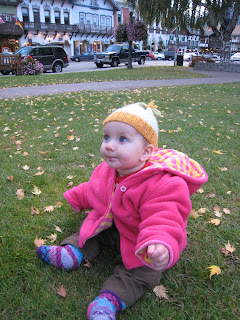
In a stroke of luck, Jennifer and I were both not working. So we took Mirabelle on another camping trip. This time, like the previous out to the warmer, sunnier side of the mountains.


We drove out Wednesday morning and did pretty good timing the drive with Mirabelle's nap schedule. We opted to check out the Aplets and Cotlets (Liberty Orchards) store in Cashmere as our first stop on the warm side. It wasn't really that interesting. And after a few samples, we continued east to the Mission Ridge ski area for a short hike. Unfortunately, this was not well timed with naps, and Mirabelle was a bit over tired when we placed her into the new back pack for the hike. She whined most of the twenty minutes or so we went uphill, and then we took her out for a snack and to see if she would calm down.


No luck with the calming, and we headed back down the hill where she fell asleep moments before returning to the car. Since it was chilly, we just headed back to Leavenworth after a stop at a market on Highway 2.


After playing in town a bit, we headed to Eight Mile Campground for the night. Where we ate dinner, and then had a good night's sleep before being waken up by the camp host. We drove into town and hiked the Nordic trails at the ski area before leaving to come back home. One stop up at Stevens Pass for Mirabelle to stretch her legs, and we were in the final leg of our journey.